


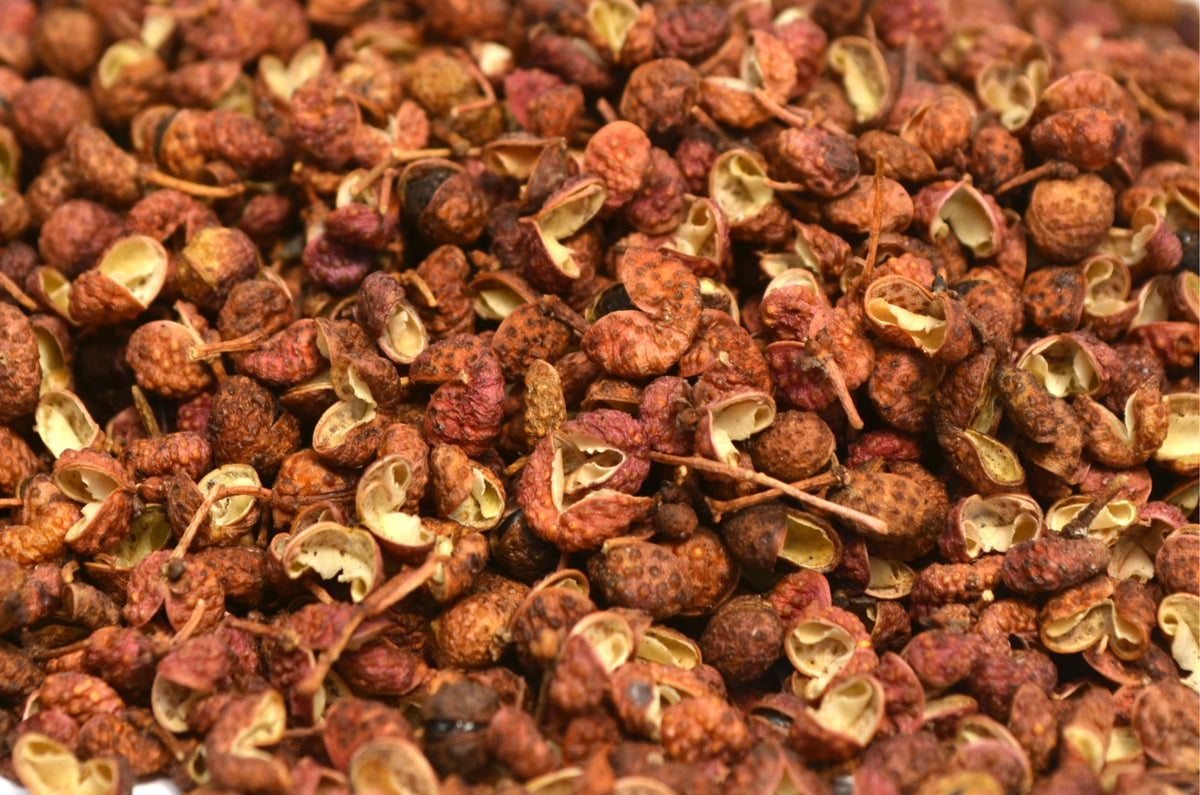
Red Sichuan pepper, despite its name, is not related to black pepper and works differently from typical hot spices. After a few peppercorns the tongue and lips begin to go slightly numb and vibrate, joined by a citrusy, floral and slightly woody aroma. It is the backbone of Sichuan cooking, where the tingle is combined with the heat of chilli. In a home kitchen it transforms ordinary chilli oil, salt for chips and roast chicken.
The spice that tingled before chilli reached China
Antiquity
Sichuan pepper, huajiao in Chinese, is one of China's oldest spices. Its seeds have been found in graves from the Warring States period and the Han dynasty, more than two thousand years old, and it is already named in the Shennong bencao jing, compiled in the Han period. In the Book of Songs huajiao appears as a symbol of fertility and abundance. In Han palaces the walls of the empresses' chambers were plastered with clay mixed with Sichuan pepper to make them fragrant.
The Middle Ages and the early modern period
Until the 16th century Sichuan pepper, ginger and other native spices were the main sources of heat in Chinese cooking. Only then did chilli from the Americas reach China through the southern ports, and in Sichuan it combined with huajiao into the mala flavour, tingling and hot. This combination gave rise to dishes known around the world today, including mapo tofu and kung pao chicken. The best pepper from around Hanyuan was sent to the emperor as tribute, hence the name gongjiao, tribute pepper.
How Sichuan pepper is made
Red Sichuan pepper is the husks of the fruits of a tree of the genus Zanthoxylum, most often Zanthoxylum bungeanum, a relative of citrus. The fruits are picked in autumn, when they turn red, and dried until the husks split open and the black seeds partly fall out.
How it is used today
- Sichuan cooking. Mapo tofu, kung pao chicken, cold cucumbers with chilli oil and hotpot, with toasted and ground pepper added at the end or at the table.
- Chilli oil and sauces. Whole pepper heated in oil with chilli, garlic and ginger passes its aroma and tingle into the oil, which is then used for dumplings, noodles and vegetables.
- Salt and sprinkling blends. Sichuan pepper salt for chips, roast potatoes, fried chicken and tofu, and an ingredient of Chinese five-spice.
- Beyond Asia. A pinch in a marinade for duck, in minced meat for burgers, in dark chocolate and in vanilla ice cream, where the tingle comes as a surprise.
In a single blend Sichuan pepper goes well with black pepper and long pepper. The other whole peppercorns are in our Peppercorns collection.
Sichuan pepper in your kitchen cupboard
Sichuan pepper adds something to cooking that black pepper does not, and salt and oil made with it wait in the cupboard for the next occasion. It is a spice for people who cook Asian dishes or like to see how a single ingredient changes a familiar flavour.
How to use it
Toasting brings out the most aroma. Put the pepper in a dry frying pan and heat it over a low flame for 2 to 3 minutes, stirring, until it starts to smell and darkens slightly. Let it cool, grind it in a mortar or grinder and sift it through a sieve to get rid of the hard seeds and stalks.
For 2 servings, half to one teaspoon of ground pepper is enough, because a larger amount gives a tingle that covers everything else. Whole pepper can also be heated in oil and removed before serving. Add it towards the end of cooking, because long cooking takes away the aroma and leaves bitterness.
Frequently asked questions
Is Sichuan pepper real pepper?
No, although the name suggests it. Black pepper is the fruit of a climbing vine of the pepper family, while Sichuan pepper is the husks of the fruits of a tree of the genus Zanthoxylum, a relative of citrus. The name comes from the way it is used.
How does red differ from green Sichuan pepper?
Red has a warmer, floral and woody aroma, and a tingle that builds slowly and lasts a long time. Green, from a related species, smells more sharply of citrus, and tingles faster and more briefly. Red more often goes into braised dishes and oil, green into fish and cold dishes.
Why are there black seeds in the pack?
They are seeds from inside the fruits, which cannot be fully separated from the husks. They have no aroma and crunch between the teeth, which is why the pepper is sifted through a sieve after grinding.
What causes the tingling?
The tingling comes from hydroxy-alpha-sanshool, a compound in the husks that mainly stimulates the nerve endings responsible for touch, which is why you feel a tingle on the tongue.
Sources
- Shennong bencao jing, compiled in the Eastern Han period (1st–2nd century AD), entry on huajiao.
- Pengfei Sheng, Hui Zhou, Jian Liu, Hongen Jiang, Some like it hot: Sichuan pepper (Zanthoxylum bungeanum) and other spices from a late Bronze Age kingdom (Chu State) in Hubei, China, Archaeological and Anthropological Sciences 12, 2020, article 249.
- Fuchsia Dunlop, The Food of Sichuan, London 2019, chapter “The Sichuanese Kitchen” and the entry on Sichuan pepper in the glossary of ingredients.
- Bruce P. Bryant, Igor Mezine, Alkylamides that produce tingling paresthesia activate tactile and thermal trigeminal neurons, Brain Research 842(2), 1999, pp. 452–460.
- Nobuhiro Hagura, Harry Barber, Patrick Haggard, Food vibrations: Asian spice sets lips trembling, Proceedings of the Royal Society B 280, 2013, article 20131680.




