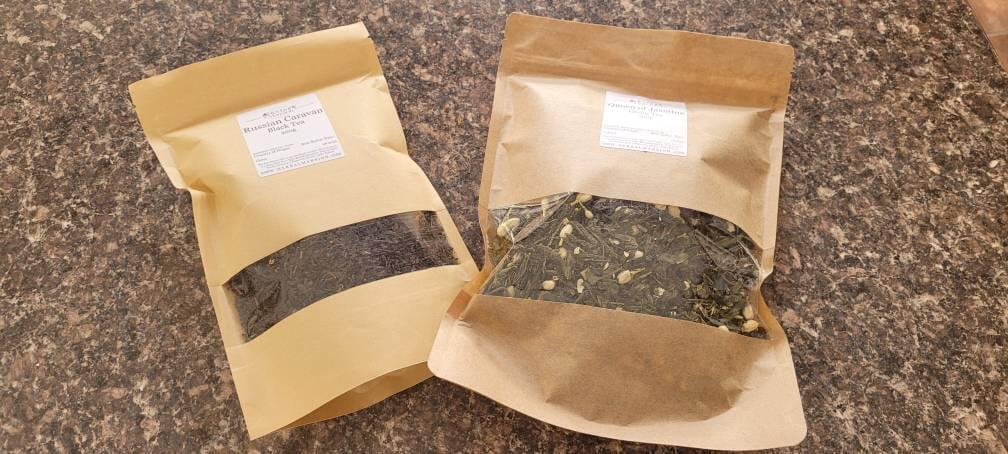


Queen of Jasmine is a green jasmine tea: Sencha with whole jasmine buds and added jasmine flavouring. The infusion is pale green, light and grassy, and the scent of jasmine rises above it from the first sip. Sencha leaves release their flavour quickly, so they are brewed briefly. It is a tea for several infusions during the day.
Sencha with jasmine buds
Where Sencha began
Sencha originated in Japan, in the area around Uji. Ukers credits its invention to Nagatani, a tea maker from Uji, who in 1738 began steaming and rolling young leaves instead of roasting them in a pan. This way of processing caught on in Japan and became the basis of today's Sencha. Ukers calls it a commercial tea, meaning an ordinary tea for everyday drinking. It used to be rolled by hand until machines replaced this work.
Steam instead of a pan
Most Chinese green teas are fixed with a hot pan, while Japanese teas are usually fixed with steam. The difference lasts a few dozen seconds, but it changes the taste of the infusion. A pan leaves notes of nuts and chestnuts, steam leaves notes of grass and seaweed. Ukers divides Japanese teas into grades, in which Sencha is the commercial tea, Bancha the coarser leaf for household use, and Gyokuro the shaded tea of the highest grade. Today the name Sencha refers to a way of processing, which is why it is also made outside Japan. The Sencha in Queen of Jasmine is made in China.
How Queen of Jasmine is made
The picked leaves are heated shortly after harvest to stop oxidation. The leaves are then rolled in several stages while being gradually dried. Finally, the tea is given a final drying and sorted. Whole dried jasmine buds and jasmine flavouring are mixed into the finished Sencha.
How it is used today
- A short brew without additions. A light, grassy infusion with jasmine in the scent.
- Several infusions from one portion. The leaves stand up to two or three infusions.
- Alcohol-free spritz. The cooled infusion with sparkling water and lemon.
- For desserts. An infusion with jasmine gives its scent to cream and custards.
We also stock plain Sencha, Jasmine Princess and Jasmine Flower Tea separately. You will find our other green teas in the Loose Green Tea collection.
Queen of Jasmine in your tea cupboard
This is a tea for people who like light, grassy green teas and want jasmine with them. Sencha gives the jasmine a clean, grassy background.
Frequently asked questions
Is this tea flavoured?
Yes, this tea has added jasmine flavouring.
Where is Queen of Jasmine made?
In China, in the Japanese style: Sencha green tea with whole jasmine buds and added jasmine flavouring.
How does it differ from Jasmine Princess?
They differ in their base. Queen of Jasmine has a Sencha base, while Jasmine Princess has a Bancha base, a tea from a later harvest.
Can the jasmine buds be taken out of the infusion?
They can, but they do not have to be. The buds are edible and float on the surface of the infusion after the water is poured. If you prefer a clear infusion, strain them out together with the leaves.
Does Queen of Jasmine contain caffeine?
Yes. The amount of caffeine in the infusion depends on the quantity of leaves and the brewing time.
Can I drink it during pregnancy or with medication?
It contains caffeine, so in these situations ask a doctor or pharmacist. A product description does not replace their advice.
Sources
- William H. Ukers, All About Tea, New York 1935, vol. I, chapters I–II, pp. 9–10 (Nagatani and the invention of Sencha in 1738), chapter XIII “Tea Characteristics”, pp. 234–236 (grades of Japanese tea) and chapter XVI, pp. 318–319 (hand and machine rolling).
- Mary Lou Heiss, Robert J. Heiss, The Story of Tea: A Cultural History and Drinking Guide, Berkeley 2007, chapter on Japan, section “Japan's Sencha: A Favorite National Tea”, p. 169.
- Kevin Gascoyne, François Marchand, Jasmin Desharnais, Hugo Américi, Tea: History, Terroirs, Varieties, Richmond Hill 2011, chapter on Japan, entry “Sencha”.
- EFSA, Scientific Opinion on the safety of caffeine, EFSA Journal 2015, 13(5):4102.