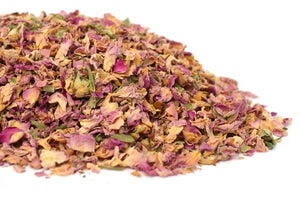
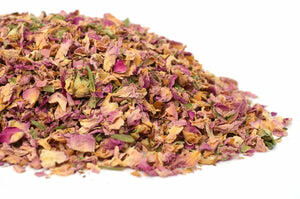
Dried pink rose petals have a gentle rose scent and a delicate, slightly astringent taste. Rose petals have been dried for thousands of years, from Persia to India, and they are still used in the same ways: for infusions, for sugar, for sweet dishes and for baths. Dried pink rose petals are added to black tea and herbal blends, ground with sugar, sprinkled over desserts and rice, and outside the kitchen they are used in bath salts, soaps and potpourri.
A rose from a Persian garden
The flower of poetry
In Persian the rose, gol, simply means “flower”, and the rose garden, golestan, became the title of one of the most famous books of Persian prose, which Saadi of Shiraz completed in 1258. The rose appears in the poems of Hafez, in miniatures and on carpets, and Shiraz is still associated with rose gardens today. The petals were gathered there early in the morning, before the sun took away their scent, and dried in shade or distilled straight away.
Rose water from Kashan
Persian scholars described the distillation of the petals in the 10th and 11th centuries, and rose water, golab in Persian, became both a flavouring and a perfume. Kashan in central Iran is still famous for its rose water. In the surrounding villages people hold golabgiri, the harvest of the Damask rose and the distilling of rose water in copper stills. In the Middle East and in India dried rose petals became part of everyday cooking, going into the advieh spice blend, rice, yoghurt and ice cream, and in India people made gulkand, petals ground with sugar and left to mature in the sun.
How dried rose petals are made
The rose flowers are picked in the morning, when fully open, and the petals are then separated from the sepals and dried in shade in a thin layer, so that they keep their colour and scent. Dried petals are thin, light and wrinkled, and their shade varies between batches, because it depends on the harvest and the drying. In Poland, rose petals ground with sugar are used to fill pączki, the doughnuts eaten on Fat Thursday, the last Thursday before Lent.
How it is used today
- Tea and infusions. Half a teaspoon of petals in black tea, in rooibos and in herbal blends, and the petals on their own make a light, floral infusion.
- Sugar and desserts. Rose sugar, syrups, ice cream, panna cotta, a sprinkle for cakes, petals in cake mixture and on rice.
- Bath and home cosmetics. An infusion for the bath, petals in bath salt, in soaps and in oils for macerating.
- Crafts. Potpourri, wedding confetti, cards and filling for scented wardrobe sachets.
Other forms of rose, including Pink Rose Buds and Red Rose Petals, are in our Roses collection.
Rose petals in your home cupboard
Only a few petals are needed to bring a rose scent to a dessert or a tea. They are an addition for people who like floral notes in their tea and desserts, or who make their own cosmetics and flavoured sugars at home.
More ways to use it
- In the kitchen. Scatter the petals over desserts and rice just before serving, and add them to cake mixture together with the flour. For rose sugar, mix 2 tablespoons of petals with 200 g of sugar and leave in a jar for a week. Petals lightly crushed between the fingers release more scent.
- Bath. For a bath, brew a handful of petals in a litre of water that has just boiled, leave covered for a quarter of an hour, strain and pour the infusion into a bath of warm water.
Frequently asked questions
Are rose petals edible?
Yes. These are rose petals intended for culinary use, used in infusions, sugar, desserts and as decoration. They contain no caffeine.
How do petals differ from rose buds?
Petals are soft, release their scent quickly and are suited to cooking and sugar. Buds are whole closed flowers, firmer, for infusions and decoration. We also stock pink rose buds and red rose petals.
Why is the infusion not pink?
The pigment in rose petals changes colour depending on acidity. In plain water the infusion is straw-coloured or amber, and when lemon is added it turns pink.
Where do the petals come from?
The current batch comes from Iran.
Sources
- Jennifer Potter, The Rose: A True History, London 2010, chapters on the rose in Persia and on the Damask rose.
- Peter Harkness, The Rose: An Illustrated History, Buffalo 2003, chapter on the roses of the East.