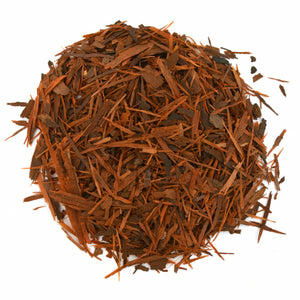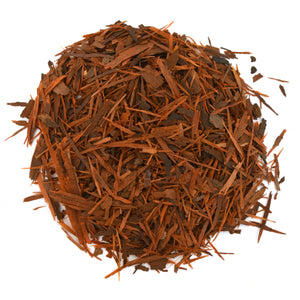


Dried lapacho bark, also sold as pau d'arco, is the bark used for lapacho tea: the cut bark of the pink lapacho tree, Handroanthus impetiginosus, long known as Tabebuia impetiginosa. It is simmered in water as a bark tea, and the same tree gives some of the hard timber traded as ipê.
A tree that flowers before its leaves
The pink lapacho
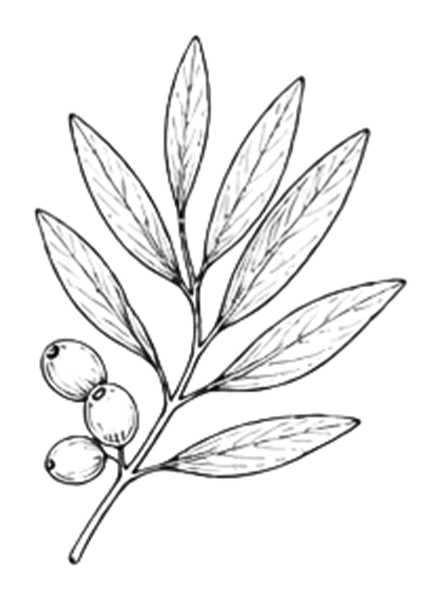
Lapacho is a medium to large tree, about 8 to 30 metres tall, with a trunk 60 to 100 cm across. Its leaves are divided like an open hand into five leaflets. The flowers are large and tubular, usually pink or magenta and only rarely white. In the southern hemisphere the tree flowers between July and September, before the new leaves appear, so the whole crown turns pink. It grows wild from Mexico and Central America to Bolivia, Paraguay, Argentina and Brazil, and it is widely planted in towns and cities.
Tajy, ipê-roxo and pau-d'arco
In Brazil the tree is called ipê-roxo, pau-d'arco and lapacho, among other names. In Paraguay it is tajy, its Guarani name. In 2012 Paraguay declared all trees of the genera Tabebuia and Handroanthus known as lapacho or tajy its national tree.
Timber, dye and tea
Ipê wood
The wood is heavy and hard and resists wood-boring organisms. It is sold as ipe, lapacho or Brazilian walnut, mostly from the related H. serratifolius but also from H. impetiginosus, and goes into decking, flooring, exterior timber and tool handles. Brazilian uses also include bridges, railway sleepers, musical instruments and bowling balls.
The inner bark
Boiled bark gives a dye that has been used to colour cotton and silk. Lapacho tea is generally made from the inner red bark, with the rough outer bark removed.
How it is used today
- Bark tea. The cut bark is simmered in water rather than steeped.
- Through the day. Our supplier suggests drinking the tea in small portions through the day.
For other barks, see Catuaba Bark and Cat's Claw. More single herbs are in our Single Herbs collection, and other plants for the cup are in Herbal Tea.
Lapacho bark in your cupboard
Our supplier describes the flavour as nutty and woody, slightly spicy and at the same time sweet. Keep the bag tightly closed in a cool, dry, dark place. Taste varies between batches.
Frequently asked questions
Is pau d'arco the same as lapacho?
Yes. Pau d'arco is one of the Portuguese names used in Brazil and lapacho is the Spanish name. Here both mean the bark of Handroanthus impetiginosus, though the names are also used for related trees.
How do I make lapacho tea?
Add 1 to 2 teaspoons of cut bark to 200 ml of water, bring to the boil, simmer on a low heat for 15 minutes, then strain.
Can I drink it during pregnancy or with medication?
It is not suitable during pregnancy or breastfeeding, for children, or for people with liver or kidney disease. Do not drink it for longer than 6 weeks. If you take medication or have a health condition, ask your doctor before drinking herbal infusions.
Where does the lapacho tree grow?
It is native to the Americas, from Mexico and Central America to Bolivia, Paraguay, Argentina and Brazil.
Sources
- Salomão A.N., Camillo J., Handroanthus impetiginosus: Ipê-roxo, in Plantas para o Futuro: Região Centro-Oeste, Embrapa, alice.cnptia.embrapa.br, accessed 22 November 2026.
- Wikipedia, Handroanthus impetiginosus, en.wikipedia.org, accessed 22 November 2026.
- Paraguay, Ley N.º 4631 que declara árbol nacional al lapacho (tajy), 2012, bacn.gov.py, accessed 22 November 2026.
- El Nacional, Los lapachos, legado de Tupã, engalanan y colorean el Paraguay, elnacional.com.py, accessed 22 November 2026.
- The Wood Database, Ipe, wood-database.com, accessed 22 November 2026.
- Abgrenzungsbeirat (Austria), Gutachten zu Lapacho Rinde, 2008, basg.gv.at, accessed 22 November 2026.