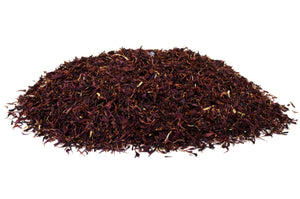
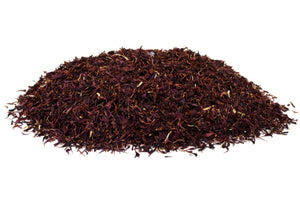
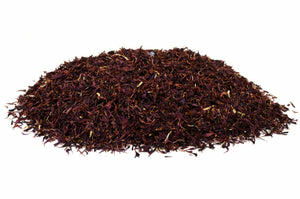
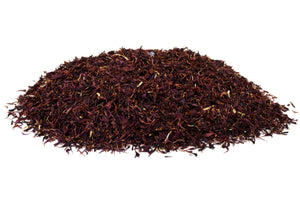
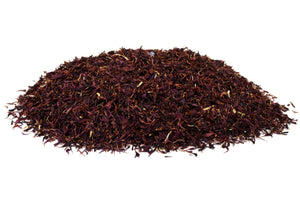
Purple cornflower petals are the dried petals of a garden variety of cornflower, used mainly as decoration. The cornflower is associated with blue, but varieties with purple, pink and white petals, bred from the same wild flower, have long been grown too. Dried purple petals are added to tea blends, to desserts, to potpourri, soaps and confetti. They taste mild and do not change the character of a dish.
Where coloured cornflowers came from
Garden varieties
The wild cornflower is blue, but among thousands of plants in a field there were pink, white and purple ones. Gardeners collected seeds from them and fixed the colour over successive generations, which is why cornflowers in several colours have long grown in European gardens next to the blue original. Coloured petals come from such garden varieties grown on plantations.
The emperor’s flower
In Prussia the cornflower became a dynastic flower. According to a story retold in the 19th century, Queen Louise, fleeing from Napoleon’s troops in 1806, stopped in a field with her children and wove cornflower wreaths for them to calm them down. One of those sons later became Emperor Wilhelm I and wore a cornflower in his buttonhole for the rest of his life, and the flower was called the Kaiserblume. After the unification of Germany in 1871, the blue cornflower became a symbol of the empire.
How purple cornflower petals are made
The purple varieties are grown on plantations, the flowers are picked in full bloom and dried in shade, and then the petals are separated from the flower heads and sifted. In 2005 Kosaku Takeda’s team showed in Nature that the blue of the wild cornflower comes from a large complex of pigment molecules and metal ions. The shade of the petals varies slightly between batches, because it depends on the harvest and the weather.
How it is used today
- Tea blends. Purple petals for green tea, for blends with lavender and for fruit teas, where a dark colour shows up better than blue.
- Desserts. A topping for cakes, individual desserts and ice cream, and for pale icing and creams, against which the purple stands out clearly.
- Crafts. Potpourri, soaps, bath bombs, cards and confetti in shades of purple and pink.
- Drinks. Lemonades, cocktails and ice cubes with petals.
Other colours of cornflower petals, including the classic Blue Cornflower Petals and Pink Cornflower Petals, as well as Lavender, are in our Flowers & Petals collection.
Purple cornflower in your home cupboard
Purple cornflower petals are chosen wherever blue would be too light: on dark tea blends, on white icing or in potpourri with lavender. They are an addition for people who put together their own blends, decorate desserts and make homemade cosmetics in purple and pink tones.
More ways to use it
- Desserts. The petals are ready to use. Scatter them over desserts just before serving, because in contact with moist cream they quickly lose their colour.
- Soap. Add the petals at the end, to the finished soap mass, so that they keep their colour.
- Potpourri. Add the petals after the salt with essential oil, the lavender and the rose buds, at the very end, so that they do not crumble.
- Tea blends. A teaspoon of petals is enough for 50 g of tea, mixed with the leaves.
Frequently asked questions
Are purple cornflower petals edible?
Yes. They are petals of an edible variety of cornflower, used as an addition to teas, desserts, salads and drinks. They contain no caffeine.
Is purple cornflower a different species from blue?
It is the same species, the cornflower, in a garden variety with purple petals. It differs only in colour, and the taste and the way it is used are the same.
What other cornflower colours do you stock?
We stock cornflower petals in blue, pink, light pink and white, and whole pink cornflowers separately. They are all in the same collection of the shop.
Where do the petals come from?
The current batch comes from Albania.
Sources
- Masaaki Shiono, Naohiro Matsugaki, Kosaku Takeda, Structure of the blue cornflower pigment, Nature 436, 2005, p. 791.
- Kosaku Takeda, Blue metal complex pigments involved in blue flower color, Proceedings of the Japan Academy, Series B 82(4), 2006, pp. 142–154.
- Riklef Kandeler, Wolfram R. Ullrich, Symbolism of plants: examples from European-Mediterranean culture presented with biology and history of art. September: Cornflower, Journal of Experimental Botany 60(12), 2009, pp. 3297–3299.
- Gyula Pinke, Viktória Kapcsándi, Bálint Czúcz, Iconic Arable Weeds: The Significance of Corn Poppy, Cornflower, and Field Larkspur in Hungarian Ethnobotanical and Cultural Heritage, Plants 12(1), 2023, art. 84.
- Zbigniew Podbielkowski, Barbara Sudnik-Wójcikowska, Słownik roślin użytkowych [Dictionary of useful plants], Warsaw 2003, entry “Chaber bławatek”.