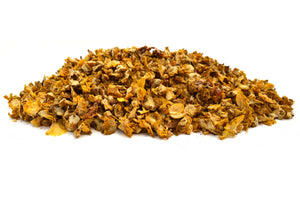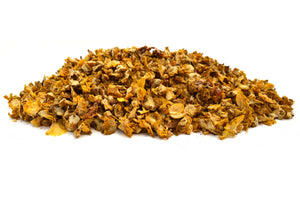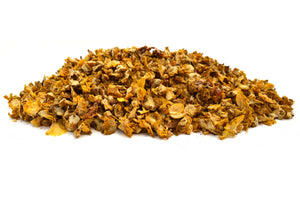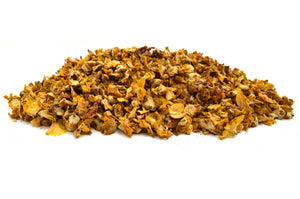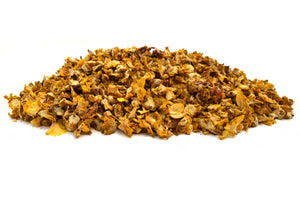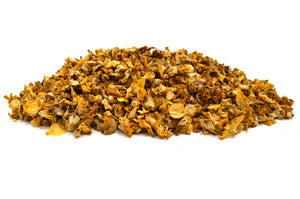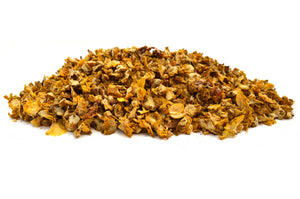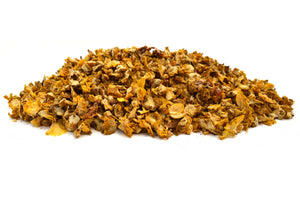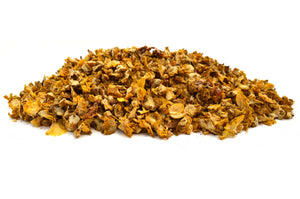


Dried mullein flowers come from mullein, genus Verbascum, whose yellow flowers grow flat and five-lobed, set closely along a tall, woolly flower spike. The English name comes from the Latin mollis, soft, after the velvety leaves.
The soft-leaved plant
A woolly spike
Mullein belongs to the family Scrophulariaceae. Its leaves, stems and bracts are covered in hairs, which gives the plant a downy white appearance. Unlike foxglove, mullein does not have to open its lowest flowers first. In the common mullein, Verbascum thapsus, for example, the flowers are about 25 mm across, the plant reaches about 2 m and the tall flower spike rises in its second year. The common mullein grows in dry, sunny places, including coastal dunes, and on stony ground by roadsides, on waste ground and along railway embankments.
Soft, bearded and full of names
The genus name Verbascum is usually traced to a Latin word for “bearded”. The tall spike gave mullein the names Aaron’s rod and Jacob’s staff, and other folk names include Adam’s flannel, beggar’s blanket, hedge-taper, Jupiter’s staff, velvet dock and witch’s taper.
Wicks, torches and dye
Before cotton came into wide use, the plant was used for lamp wicks, which gave it the name candlewick plant. Dried stalks were traditionally dipped in tallow and burned as torches. In folklore, the name hag’s taper comes either from witches lighting their spells with it or from the belief that a stalk dipped in tallow kept them away; “hag” goes back to the Old English hægtesse, a witch. The flowers also give a bright yellow dye for cloth, which turns brown when an alkali is added.
How it is used today
- Flower infusion. One to two teaspoons per cup, steeped covered in hot water, then strained through a paper filter or fine cloth to catch the fine plant hairs.
- Natural dyeing. The flowers give a yellow dye for fabric.
For other flowers to steep, try Red Clover or Pink Heather. More dried flowers are in our Flowers & Petals collection, and ingredients for your own blends are in Herbal Tea.
Mullein flowers in your home cupboard
Dried mullein is light and fluffy, so tea guides treat one teaspoon per cup as the minimum and suggest two. Keep paper coffee filters or a piece of muslin by the jar for straining. The colour of the flowers varies between batches, and so does the taste, so brew your first cup and taste it before brewing longer.
Frequently asked questions
Why strain mullein flower infusion through a paper filter?
To catch the fine plant hairs, which can pass through an ordinary strainer or tea infuser. The flowers carry fewer hairs than the leaves, but a paper coffee filter or a double layer of muslin is still recommended.
Which mullein species are these flowers from?
They are from the genus Verbascum. The species is not specified for this batch. Much of what is written about mullein describes the common mullein, Verbascum thapsus.
Are mullein flowers different from mullein leaf?
Yes. This product is the dried flowers only. One seller notes that the flowers make a sweeter infusion than the leaves, which are earthier.
Can I drink it during pregnancy or with medication?
If you are pregnant, breastfeeding, taking medication or have a health condition, ask your doctor before drinking flower infusions.
Where do the flowers come from?
The current batch comes from Albania.
Sources
- First Nature, Verbascum thapsus, Great Mullein, accessed 19 November 2026.
- The Ohio State University, CFAES, Common mullein, Ohio Perennial and Biennial Weed Guide.
- Missouri Botanical Garden, Verbascum thapsus, Plant Finder.