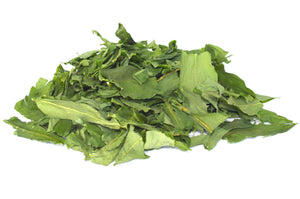
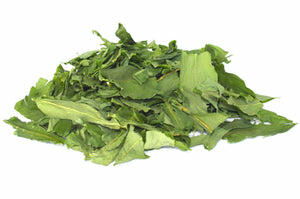
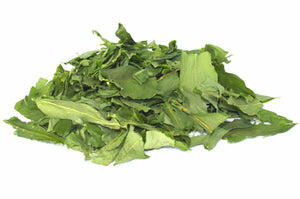
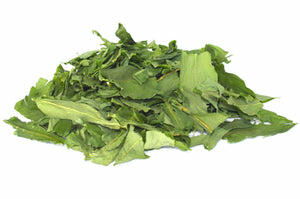
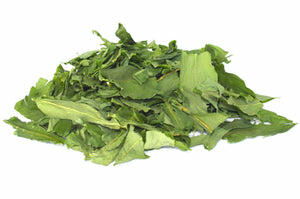
Dried bear’s garlic is the leaf of wild garlic, Allium ursinum, crumbled into food as a seasoning rather than brewed. On the plant the leaves are long, pointed and oval with smooth edges, rising straight from the bulb, and a crushed leaf smells unmistakably of garlic.
A plant of old woodland
Bulbs and star-like flowers
Wild garlic is a spring-flowering bulb of damp deciduous woodland and a member of the onion family, the Allium genus. From April it carries rounded clusters of small, white, star-like flowers on a leafless stalk. These early flowers are an important food for pollinators such as hoverflies and butterflies. The plant spreads mainly by its bulbs, only rarely from seed.
An ancient-woodland indicator
The Woodland Trust regards wild garlic as an ancient-woodland indicator plant. In spring its garlicky scent fills the woods where it grows.
Ramsons and the bear
A double plural
Wild garlic has many names: ramsons, bear’s garlic, bear leek, buckrams, wood garlic and broad-leaved garlic. Ramsons goes back to the Old English hramsa. Its plural was hramsan, so “ramsons” is in fact a double plural.
Of the bear
The Latin ursinum means “of the bear”, a name traditionally linked to bears digging up the bulbs.
Wild garlic in the kitchen
Fresh in spring
Fresh leaves are eaten raw in salads, wilted like spinach, or blended into soups and pesto, and they are best picked before the flowers open. The white flowers are edible too and are scattered over salads. Cooks describe a gentle, green garlic flavour, softer than a garlic clove.
A trend from restaurant kitchens
In Germany, where it is called Bärlauch, the trend for wild garlic came from top restaurant kitchens in the 1980s and grew into a seasonal favourite.
How it is used today
- Finishing dishes. Crumbled into soups, sauces, risotto and pasta at the end of cooking.
- Butter and soft cheese. Mixed into butter, soft cheese, dips and dressings.
- Seasoned salt. Ground together with salt.
Sellers describe dried wild garlic as the year-round version of a short spring season. More seasonings are in our Culinary Herbs collection, and more single plants are in Single Herbs. Other leaves in this range include Whole Nettle Leaf and Dandelion Leaf.
Bear’s garlic in your home cupboard
Add it late, because heat softens the aroma. Start with a pinch and add more to taste. Keep the bag tightly closed in a cool, dry, dark place. Taste varies between batches.
Frequently asked questions
Is bear’s garlic the same as wild garlic?
Yes. Bear’s garlic, wild garlic and ramsons are common names for the same plant, Allium ursinum. It is also called bear leek, wood garlic and broad-leaved garlic.
How do I use dried bear’s garlic?
Crumble a pinch over a dish at the end of cooking, or once the pan is off the heat. It also works in butter, soft cheese, dips, dressings and bread dough. Add more to taste.
Why is it a limited quantity?
It comes from our own small harvest, so stock is limited.
Can I use it during pregnancy or with medication?
If you are pregnant, breastfeeding, taking medication or have a health condition, ask your doctor before using it.
Where does bear’s garlic come from?
The current batch comes from our own harvest in Poland.
Sources
- Woodland Trust, Wild garlic, woodlandtrust.org.uk, accessed 20 November 2026.
- Plantlife, Wild Garlic, plantlife.org.uk, accessed 20 November 2026.
- The Wildlife Trusts, Wild garlic, wildlifetrusts.org, accessed 20 November 2026.
- Missouri Botanical Garden, Allium ursinum (Plant Finder), missouribotanicalgarden.org.
- SZ/BZ, Der Trend kam aus der Sterneküche, szbz.de.